IEC 61643-41:2025 vs. IEC 61643-31 – Two Key Standards for DC Surge Protective Devices
 1. Scope of Application
IEC 61643-41:2025
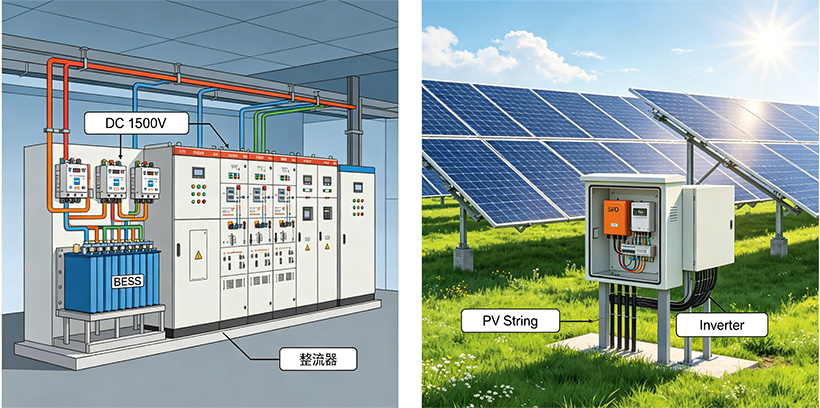
This standard applies to SPDs connected to general DC low-voltage power systems with a rated voltage up to 1500 V DC. These systems are typically supplied by power sources with a linear voltage-current characteristic, such as batteries, rectifiers, or conventional DC power supplies. The standard covers protection against indirect and direct effects of lightning or other transient overvoltages.
IEC 61643-31
This standard specifically applies to SPDs used in photovoltaic (PV) systems, including both AC and DC sides of PV installations. It addresses the unique characteristics of PV systems, such as reverse current handling, operation under varying solar irradiance, and the specific transient overvoltages seen in solar farms and rooftop PV arrays.
Key takeaway: IEC 61643-41 is for general DC power systems, while IEC 61643-31 is dedicated to PV applications.
2. Voltage Levels and System Characteristics
| Feature | IEC 61643-41:2025 | IEC 61643-31 |
|---|---|---|
| Maximum DC voltage | Up to 1 500 V DC | Typically up to 1 500 V DC on DC side (but with PV-specific conditions) |
| Source characteristics | Linear voltage-current (e.g., batteries, rectifiers) | Nonlinear, current-limited (PV arrays) |
| Fault current behavior | Higher prospective short-circuit currents | Lower, source-dependent short-circuit currents |
Because PV systems are nonlinear and their fault current is limited by irradiance and array design, IEC 61643-31 includes tests that account for these conditions, whereas IEC 61643-41 assumes a stronger, linear source.
3. Test Requirements and Performance
IEC 61643-41 focuses on:
Performance under linear source conditions.
Temporary overvoltage (TOV) stresses typical for DC power systems.
System fault conditions, including expected short-circuit current.
IEC 61643-31 includes:
PV-specific tests, such as reverse overload and ability to interrupt DC arcs.
Testing under simulated PV source conditions (nonlinear I-V curves).
Additional safety requirements for use in string and array combiners.
Important: An SPD compliant with IEC 61643-41 may not be suitable for direct installation on a PV array DC side, and vice versa.
4. Overlap and Exclusions
IEC 61643-41 explicitly excludes SPDs for PV applications (see Note 2 in the standard).
IEC 61643-31 is the designated standard for PV SPDs, and it references general requirements from IEC 61643-01, similar to IEC 61643-41.
Both standards, however, share a common foundation: they reference IEC 61643-01 (general requirements and tests for SPDs) and follow the same basic classification system for Type tests, though with application-specific modifications.
5. Practical Guidance for Selection
| Application | Recommended Standard |
|---|---|
| DC microgrids, battery storage systems, industrial DC power supplies, railway DC auxiliary systems (if no product standard exists) | IEC 61643-41:2025 |
| Photovoltaic solar systems – DC side (strings, arrays, combiner boxes) | IEC 61643-31 |
| Photovoltaic systems – AC side (inverter output to grid) | May use either standard depending on the source characteristics; typically IEC 61643-31 or relevant AC standard |
Conclusion
Both IEC 61643-41:2025 and IEC 61643-31 play critical roles in ensuring the safety and reliability of DC surge protection. However, they are not interchangeable. One is designed for general DC power systems with linear sources; the other is tailored to the unique behavior of PV arrays.
Choosing the correct standard is essential for regulatory compliance, system safety, and long-term reliability. If you are unsure which standard applies to your project, consult with a qualified surge protection engineer or refer to the full text of the standards for detailed technical requirements.
About Prosurge
At Prosurge, we stay up to date with the latest IEC standards to help our customers select the right surge protection solutions for every application. Contact us for expert advice on DC and PV SPD selection.